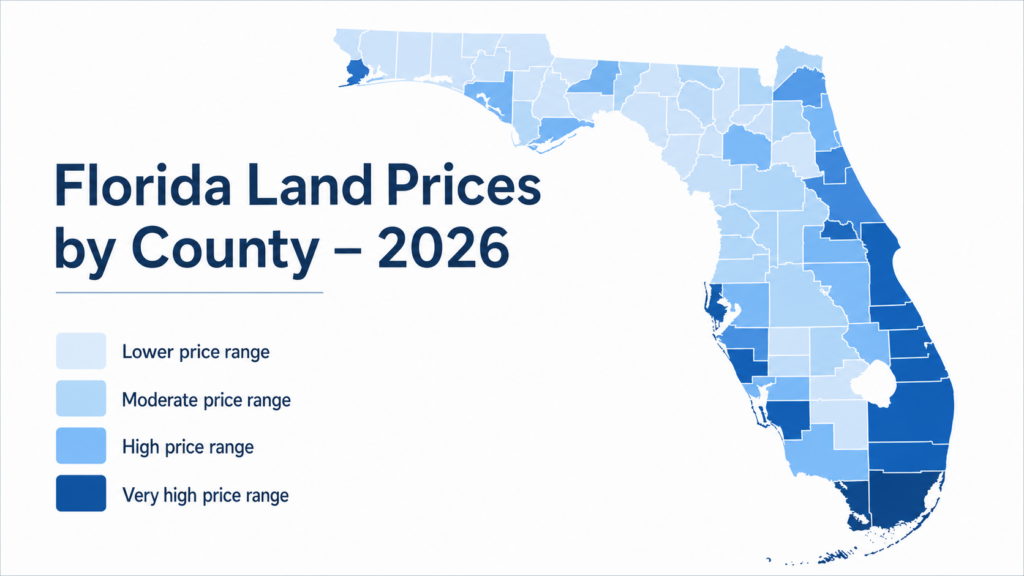
Florida Land Prices by County 2026
Florida land prices vary more by county — and even more by parcel — than almost anyone outside the state realizes. A vacant acre in rural Liberty County and a vacant acre in coastal Miami-Dade are not in the same market. They are not even in the same conversation. This page is a calm, plain-English guide to how vacant land pricing actually breaks down across Florida in 2026, so landowners can understand the lay of the land before making any decisions.
This page is a starting point, not an appraisal. Two parcels in the same county can sell at very different prices depending on access, zoning, utilities, wetlands, and title condition. Use it to get oriented — then dig deeper on your specific parcel before pricing or listing anything.
For broader market data and recurring quarterly reports, see our Florida Land Stats hub, which is the home for Florida vacant land statistics and quarterly updates.
Florida Land Prices Per Acre — All 67 Counties
Data source: Data compiled from Florida county property appraiser records, USDA NASS 2025 Land Values Summary, and Cash For Land Florida LLC transaction data from 2004–2026.
| County | Median $/Acre | Low Range | High Range | # of Sales |
|---|---|---|---|---|
| Alachua | $48,148 | $19,315 | $147,903 | 455 |
| Baker | $28,495 | $14,523 | $54,545 | 25 |
| Bay | $100,000 | $28,571 | $442,308 | 1,141 |
| Bradford | $22,308 | $13,316 | $45,365 | 108 |
| Brevard | $126,795 | $54,545 | $217,391 | 1,580 |
| Broward | $1,966,667 | $798,103 | $5,835,938 | 562 |
| Calhoun | $8,217 | $5,612 | $11,894 | 103 |
| Charlotte | $82,609 | $57,692 | $123,077 | 4,491 |
| Citrus | $43,478 | $28,458 | $70,445 | 2,775 |
| Clay | $25,252 | $14,593 | $62,680 | 352 |
| Collier | $114,146 | $52,632 | $2,392,976 | 1,216 |
| Columbia | $19,679 | $13,303 | $38,113 | 343 |
| DeSoto | $26,292 | $16,785 | $44,639 | 138 |
| Dixie | $12,620 | $9,516 | $21,627 | 262 |
| Duval | $105,263 | $49,332 | $227,273 | 651 |
| Escambia | $97,345 | $36,930 | $249,531 | 749 |
| Flagler | $311,719 | $74,356 | $820,850 | 794 |
| Franklin | $153,846 | $47,500 | $334,677 | 489 |
| Gadsden | $16,033 | $6,698 | $32,003 | 151 |
| Gilchrist | $18,041 | $12,625 | $30,000 | 178 |
| Glades | $70,018 | $37,682 | $125,000 | 116 |
| Gulf | $208,738 | $41,422 | $608,158 | 431 |
| Hamilton | $12,295 | $6,433 | $20,887 | 51 |
| Hardee | $30,828 | $20,852 | $56,537 | 94 |
| Hendry | $39,370 | $29,921 | $59,055 | 977 |
| Hernando | $51,546 | $32,459 | $95,745 | 1,106 |
| Highlands | $35,217 | $20,213 | $58,696 | 217 |
| Hillsborough | $264,595 | $106,103 | $697,750 | 846 |
| Holmes | $7,710 | $3,730 | $15,932 | 108 |
| Indian River | $162,500 | $75,758 | $285,000 | 453 |
| Jackson | $8,772 | $6,173 | $12,647 | 478 |
| Jefferson | $16,197 | $8,318 | $25,956 | 56 |
| Lafayette | $12,897 | $8,451 | $21,739 | 49 |
| Lake | $76,923 | $39,506 | $192,835 | 1,062 |
| Lee | $97,826 | $63,704 | $189,655 | 8,025 |
| Leon | $59,701 | $21,564 | $153,632 | 343 |
| Levy | $20,284 | $14,286 | $29,175 | 1,352 |
| Liberty | $12,824 | $7,902 | $25,701 | 30 |
| Madison | $10,081 | $7,212 | $14,985 | 331 |
| Manatee | $382,086 | $80,308 | $1,013,889 | 338 |
| Marion | $52,593 | $30,303 | $104,000 | 3,315 |
| Martin | $1,200,000 | $242,308 | $5,203,620 | 330 |
| Miami-Dade | $3,181,818 | $1,461,538 | $5,441,000 | 642 |
| Monroe | $1,428,571 | $579,820 | $2,416,667 | 143 |
| Nassau | $182,234 | $31,076 | $789,543 | 320 |
| Okaloosa | $71,429 | $17,209 | $452,586 | 421 |
| Okeechobee | $24,123 | $17,544 | $45,977 | 744 |
| Orange | $230,769 | $86,614 | $1,084,906 | 801 |
| Osceola | $134,331 | $36,521 | $1,538,830 | 316 |
| Palm Beach | $925,000 | $202,555 | $4,000,000 | 759 |
| Pasco | $77,670 | $44,601 | $146,667 | 649 |
| Pinellas | $1,380,000 | $692,308 | $2,977,273 | 497 |
| Polk | $98,039 | $28,846 | $250,000 | 1,637 |
| Putnam | $18,280 | $12,262 | $28,588 | 2,588 |
| Santa Rosa | $43,529 | $18,605 | $149,255 | 436 |
| Sarasota | $87,500 | $61,119 | $149,600 | 2,158 |
| Seminole | $213,675 | $79,798 | $370,000 | 289 |
| St. Johns | $86,768 | $23,755 | $800,279 | 714 |
| St. Lucie | $230,000 | $127,931 | $658,556 | 559 |
| Sumter | $57,143 | $30,661 | $100,000 | 226 |
| Suwannee | $14,272 | $9,342 | $19,231 | 551 |
| Taylor | $34,455 | $12,633 | $112,786 | 180 |
| Union | $24,288 | $16,391 | $40,096 | 20 |
| Volusia | $61,538 | $15,346 | $153,846 | 1,246 |
| Wakulla | $58,957 | $28,312 | $127,442 | 238 |
| Walton | $250,000 | $45,276 | $1,798,030 | 1,259 |
| Washington | $17,902 | $10,000 | $30,357 | 453 |
What Drives Florida Land Prices County to County
Before getting into county clusters, it helps to understand what actually moves the price of vacant land. These factors usually matter more than the county name on the deed:
Access to Utilities and Roads
Power, water, sewer or septic feasibility, and recorded legal road access are usually the biggest single drivers of vacant land value. A parcel with paved frontage and utilities at the road can sell for many multiples of an otherwise identical parcel that requires a long driveway, a well, septic, and easement negotiation.
Proximity to Metro and Coastal Markets
Florida land pricing follows growth corridors. Counties along I-4 (Tampa-Orlando), I-95 (the East Coast), I-75 (the West Coast and inland), and along the Atlantic and Gulf coasts generally trade at materially higher per-acre prices than inland rural counties.
Zoning and Buildability
Zoning controls what a parcel can become. Land zoned for single-family residential development with utilities nearby usually carries the highest per-acre values. Agricultural, conservation, recreational, and silvicultural designations typically trade lower — sometimes far lower — even on similar acreage.
Flood Zones, Wetlands, and Environmental Constraints
FEMA flood zone designations, jurisdictional wetlands, and conservation overlays can dramatically reduce usable acreage. Two ten-acre parcels can have wildly different “effective” buildable areas depending on what an environmental survey reveals.
HOA and Deed Restrictions
Some Florida lots — particularly in platted subdivisions — carry HOA dues, architectural review boards, build timelines, and minimum home size requirements. These restrictions affect both who will buy the parcel and what they will pay.
Parcel Size and Shape
Smaller, regularly shaped lots near population centers usually trade at the highest per-acre prices. Large rural acreage typically trades at much lower per-acre prices but higher total dollar amounts. Landlocked, irregularly shaped, or split-by-easement parcels almost always trade at a discount to comparable rectangular parcels.
Statewide Patterns Florida Landowners Should Know
Florida vacant land pricing breaks roughly into three high-level tiers in 2026, but every tier contains wide internal variation:
- Tier 1 — Coastal and major metro counties: Highest per-acre values, with premium coastal counties commanding multiples of statewide medians.
- Tier 2 — Secondary growth corridors and exurban counties: Strong demand from spillover growth out of Tier 1 metros, plus active builder activity in places where land remains relatively affordable.
- Tier 3 — Rural, agricultural, and Panhandle interior counties: The most affordable per-acre pricing in Florida, with values driven primarily by acreage size, timber/ranch use, and access rather than residential development demand.
A useful regional reference comes from Saunders Real Estate’s 2025 Lay of the Land Florida Market Report, which tracks ranchland and timberland transactions across the state:
| Region | 2025 Average Per-Acre (Ranch / Pasture / Timber) |
|---|---|
| Central Florida | $12,933 |
| South Florida | $9,354 |
| North Florida | $8,154 |
| Florida Panhandle | $4,679 |
Source: 2025 Lay of the Land Florida Market Report, Saunders Real Estate.
Notice the spread: Central Florida ranchland averaged roughly 2.8x Panhandle ranchland in 2025. That north-to-south pricing gradient has been a defining feature of Florida land markets for years and remains intact in 2026. For a national benchmark, USDA NASS reported Florida cropland reached $8,150 per acre in 2025, up 3.9% year over year (USDA NASS 2025 Land Values Summary).
These regional averages are useful for orientation. They do not predict what any individual residential lot or development parcel will trade for.
Florida Land Prices by County — Grouped by Cluster
Rather than list 67 counties with fabricated precise figures, this section groups counties into the clusters that most affect pricing in 2026. Within each cluster, individual counties and individual parcels still vary widely. Some counties sell faster than others.
Cluster 1 — Major Metro and Coastal Counties
These are Florida’s highest-priced land markets. Buildable residential parcels and small lots near the coast or inside metro areas often command premium per-acre prices, sometimes orders of magnitude above statewide averages.
Representative counties:
- Miami-Dade, Broward, Palm Beach (Southeast Florida / Atlantic Coast)
- Monroe (Florida Keys)
- Pinellas, Hillsborough (Tampa Bay)
- Orange, Seminole (Orlando metro)
- Sarasota, Lee, Collier (Southwest Florida coast)
- Duval, St. Johns (Jacksonville metro and northeast coast)
What landowners should know: Because urban and coastal land is largely already developed, vacant parcels are scarce. Asking prices on small infill lots can be high, but real comps depend heavily on zoning, allowable density, and lot dimensions. Premium coastal counties are also where insurance, flood-zone, and elevation considerations affect value most.
Cluster 2 — Secondary Growth Corridors
These counties sit just outside the Tier 1 metros and absorb a significant share of Florida’s population and builder demand. Vacant land in this cluster generally trades below Tier 1 levels but well above rural interior counties — and price-per-acre appreciation here has been some of the strongest in the country.
Representative counties:
- St. Lucie, Martin, Indian River (Treasure Coast — Realtor.com identified Port St. Lucie as the #1 metro in the United States for land price-per-acre appreciation since Q1 2019, at +314.0%) (Realtor.com Q1 2026 Land Report)
- Polk, Osceola, Lake, Sumter (I-4 Corridor / Central Florida exurbs)
- Pasco, Hernando, Manatee (Tampa Bay spillover)
- Brevard (Space Coast)
- Volusia, Flagler (East-Central coast and exurban)
- Nassau, Clay (Jacksonville exurbs)
What landowners should know: This is where many of Florida’s strongest medium-term land fundamentals sit. Land in the path of suburban expansion can trade at meaningful premiums to county-wide averages, particularly when utilities and infrastructure are already in place.
Cluster 3 — Rural, Agricultural, and Inland Counties
These counties cover most of Florida’s land mass but a smaller share of its population. Pricing here is driven primarily by acreage, agricultural use, recreational appeal, and access — not residential demand.
Representative counties:
- Highlands, Hardee, DeSoto, Glades, Hendry, Okeechobee (South-central agricultural belt)
- Putnam, Levy, Dixie, Gilchrist (Nature Coast / North-Central rural)
- Suwannee, Madison, Taylor, Lafayette, Hamilton (North-Central rural)
- Bradford, Union, Baker (North Central)
What landowners should know: Per-acre pricing in rural inland Florida can be a small fraction of metro pricing, but absolute dollar figures on larger tracts can still be substantial. Saunders reported North Florida ranchland averaging around $8,154 per acre in 2025 (Saunders 2025 Lay of the Land Florida Market Report). Buildability, access, and clean title matter even more here than in metro counties because the buyer pool is smaller.
Cluster 4 — Florida Panhandle (Western Counties)
Florida’s western Panhandle is its most affordable land region overall, with significant rural and timber acreage and a more separate market dynamic from peninsular Florida.
Representative counties:
- Escambia, Santa Rosa, Okaloosa, Walton (Western Panhandle, including the Emerald Coast premium beach counties)
- Bay (Panama City / coastal)
- Holmes, Washington, Jackson, Calhoun, Liberty, Gadsden (Interior Panhandle)
- Wakulla, Jefferson, Leon (Big Bend / Tallahassee region)
What landowners should know: The Panhandle includes both Florida’s lowest-priced rural land and some of the state’s premium beach counties (notably Walton’s 30A corridor and parts of Bay County). Saunders’ 2025 data put Panhandle ranchland at roughly $4,679 per acre — the lowest of any Florida region (Saunders 2025 Lay of the Land Florida Market Report). Coastal premium parcels in the same Panhandle counties can trade at multiples of those interior averages.
👇 Tell us about your property below
No obligation. No spam. Fast response.
Example Per-Acre Reference Ranges
The figures below are regional reference ranges from authoritative public reports, not appraisals or quotes for any specific parcel. Use them as orientation only. List prices on individual parcels — and especially closed sale prices — vary widely from these regional averages.
| Land Type / Region | 2025 Reference Per-Acre |
|---|---|
| Florida cropland (USDA NASS, statewide) | $8,150 |
| Panhandle ranchland / pasture | ~$4,679 |
| North Florida ranchland / pasture | ~$8,154 |
| South Florida ranchland / pasture | ~$9,354 |
| Florida ranchland 50–500 acres (avg) | $10,839 |
| Florida ranchland 500+ acres (avg) | $9,539 |
| Central Florida ranchland / pasture | $12,933 |
| Florida timberland 2025 median (fee simple) | ~$11,905 |
| Florida timberland 2024 median (fee simple) | ~$14,874 |
Sources: USDA NASS 2025 Land Values Summary; 2025 Lay of the Land Florida Market Report, Saunders Real Estate.
A few honest cautions on these numbers:
- They are averages and medians from large datasets. Any single parcel can trade well above or well below.
- They cover specific land types — ranchland, pastureland, cropland, timberland — and do not represent residential lot pricing in metro or coastal counties, which trades at very different levels.
- Online listing asking prices and closed sale prices are not the same number. Closed sale prices are typically lower, sometimes meaningfully so.
For the most current statewide land data and quarterly reports, the Florida Land Stats hub is the central reference page on this site.
Soft CTA — When the County Average Doesn’t Tell You Much
If you own Florida land and the regional ranges above don’t seem to match your situation — for example, you have title questions, no recorded access, heavy wetlands, back taxes, or you simply don’t know what a realistic offer would look like — it’s reasonable to want a no-obligation review before doing anything. The Florida Land Selling Guide walks through pricing, paperwork, and closing for owners thinking about a sale, and the broader Florida Land Resource Center gathers the rest of our educational guides for landowners.
How Land Issues Can Change the Price More Than the County
This is the part most “land prices by county” pages miss. In a market where buyers have become more selective — and 2026 is that kind of market — the issues attached to a parcel often matter more than the county it sits in.
Title Problems
Heirship gaps, missing or unrecorded deeds, old mortgages or liens that were never released, unresolved probate, boundary disputes, and tax certificates can all create title clouds. A buyer who is willing to wait through resolution will price for that delay. A buyer who is not will pass entirely. Our breakdown on selling land with title problems in Florida covers what tends to come up and how it gets resolved.
Tax Liens and Back Taxes
Delinquent property taxes and active tax certificates reduce net proceeds and add complexity at closing. They do not make a parcel unsellable, but they meaningfully affect the offers it attracts.
No Legal Access
Recorded legal access — not just a path or trail — is one of the biggest swing factors in Florida land value. Landlocked parcels and parcels with only easement access typically trade at significant discounts to similar parcels with paved or recorded road frontage.
Wetlands and Unusable Area
A ten-acre parcel that surveys out as four acres of buildable upland and six acres of jurisdictional wetlands is not really a ten-acre parcel for pricing purposes. Wetlands, conservation overlays, and FEMA flood zones can sharply reduce effective value even when the deed acreage looks attractive.
Code Violations, Open Permits, HOA Issues
These tend to fly under the radar but can stall a sale or shave value. Open permits, code violations, unresolved HOA disputes, and architectural review issues all show up in due diligence.
For a fuller treatment of how each of these issues affects sale price and timeline, the resource on selling land with issues in Florida is the deep-dive.
Bottom line: The honest answer to “what is my Florida land worth?” usually starts with the county and ends with the parcel-specific issues. The latter often weighs more.
What This Means If You’re Thinking About Selling in 2026
A few practical points for landowners weighing a sale in 2026:
- Check comps carefully — and skeptically. Online aggregator estimates rarely capture access, wetlands, or zoning differences. Look at recently closed sales in the same county and ideally the same submarket.
- Match comps to your actual parcel. Same county is not the same market. Same zip code is not the same submarket. Same road frontage and utility access is closer to a real comp.
- Asking prices are not closing prices. Online listings show what sellers hope to get, not what buyers actually paid. Closed sale data is the more honest signal.
- Carrying costs add up. Property taxes, mowing, liability, and code enforcement compound while you wait for the right retail buyer. Factor that against any potential price improvement from holding.
- Difficult parcels usually need different buyers. If your parcel has title, access, wetlands, or zoning issues, the open-market retail buyer pool may not be the right buyer pool.
Final CTA — A Direct Cash Offer If You Want One
If you’ve reviewed the regional ranges, considered the issues attached to your parcel, and you’d rather skip the listing process — or your land doesn’t fit cleanly into the “perfect comp” mold — we make direct cash offers on Florida vacant land in all 67 counties. Clean lots, problem parcels, inherited land, taxed land, landlocked parcels, wetlands-heavy parcels, and everything in between.
Visit the CashForLandFL.com homepage to request a no-obligation cash offer. There is no listing, no commission, no cleanup, and no pressure.
Frequently Asked Questions
What is the average price per acre for land in Florida?
There is no single useful average because Florida vacant land covers everything from sub-$5,000-per-acre rural Panhandle parcels to multi-million-per-acre Miami-Dade and Monroe County lots. Authoritative regional benchmarks for 2025 included Florida cropland at $8,150 per acre per USDA NASS, and Florida ranchland averaging $10,189 per acre across the state per the Saunders 2025 Lay of the Land Florida Market Report.
Which Florida counties have the cheapest vacant land?
Generally speaking, interior Panhandle counties (Liberty, Calhoun, Holmes, Washington, Jackson) and rural North-Central counties (Madison, Hamilton, Lafayette, Taylor) have Florida’s lowest per-acre pricing. Saunders’ 2025 data put Panhandle ranchland averaging $4,679 per acre — the lowest of any Florida region.
Are Florida land prices going up or down in 2026?
It depends on the land type and the region. Florida cropland appreciated 3.9% in 2025 per USDA. Statewide vacant residential land medians have been roughly flat year over year. Raw and rural land softened modestly nationally, with raw land prices down 2.4% year over year in Q1 2026 per Realtor.com. Buildable lots in growth corridors held firm or appreciated.
Why do some parcels in the same county have very different prices?
Because Florida land value is overwhelmingly parcel-specific. Within a single county — sometimes within a single road — access, zoning, utility availability, wetlands, flood zone classification, lot size and shape, HOA status, and title condition can each move a parcel’s value by a large percentage. The county is the starting point. The parcel is the answer.
How do wetlands and flood zones affect land value in Florida?
Significantly. Jurisdictional wetlands reduce buildable acreage and add permitting complexity. FEMA flood zone designations affect insurance, financing, build cost, and resale price. Two parcels with the same deed acreage in the same county can carry very different effective values once wetlands and flood-zone factors are accounted for.
How do back taxes or title problems affect what my land is worth?
They reduce both the price a parcel attracts and the buyer pool willing to engage. Unpaid taxes, tax certificates, heirship gaps, missing deeds, old liens, and unresolved boundary disputes all add time, cost, and risk to a transaction. Clean parcels typically sell faster and for higher net proceeds. Problem parcels still have real value — they usually sell to buyers who specialize in resolving these issues.
Where can I see updated Florida land statistics and quarterly reports?
Updated statewide Florida land data, quarterly reports, and county comparisons are published in the Florida Land Stats hub on this site. The first quarter 2026 Florida land market report is available there as part of the recurring report archive.
Methodology and Disclaimer
This page references publicly available data from USDA NASS, Realtor.com, Florida Realtors, Saunders Real Estate’s annual Lay of the Land Florida Market Report, and the Florida Department of Revenue parcel sales record system. All figures are presented as regional or statewide reference ranges — not appraisals, opinions of value, or quotes for any specific parcel. Reporting periods vary by source and are noted inline.
This page is for general educational and market-awareness purposes only. It is not legal, tax, surveying, zoning, valuation, or investment advice. Verify any specific parcel question with appropriate licensed professionals before making decisions.
👇 Tell us about your property below
No obligation. No spam. Fast response.